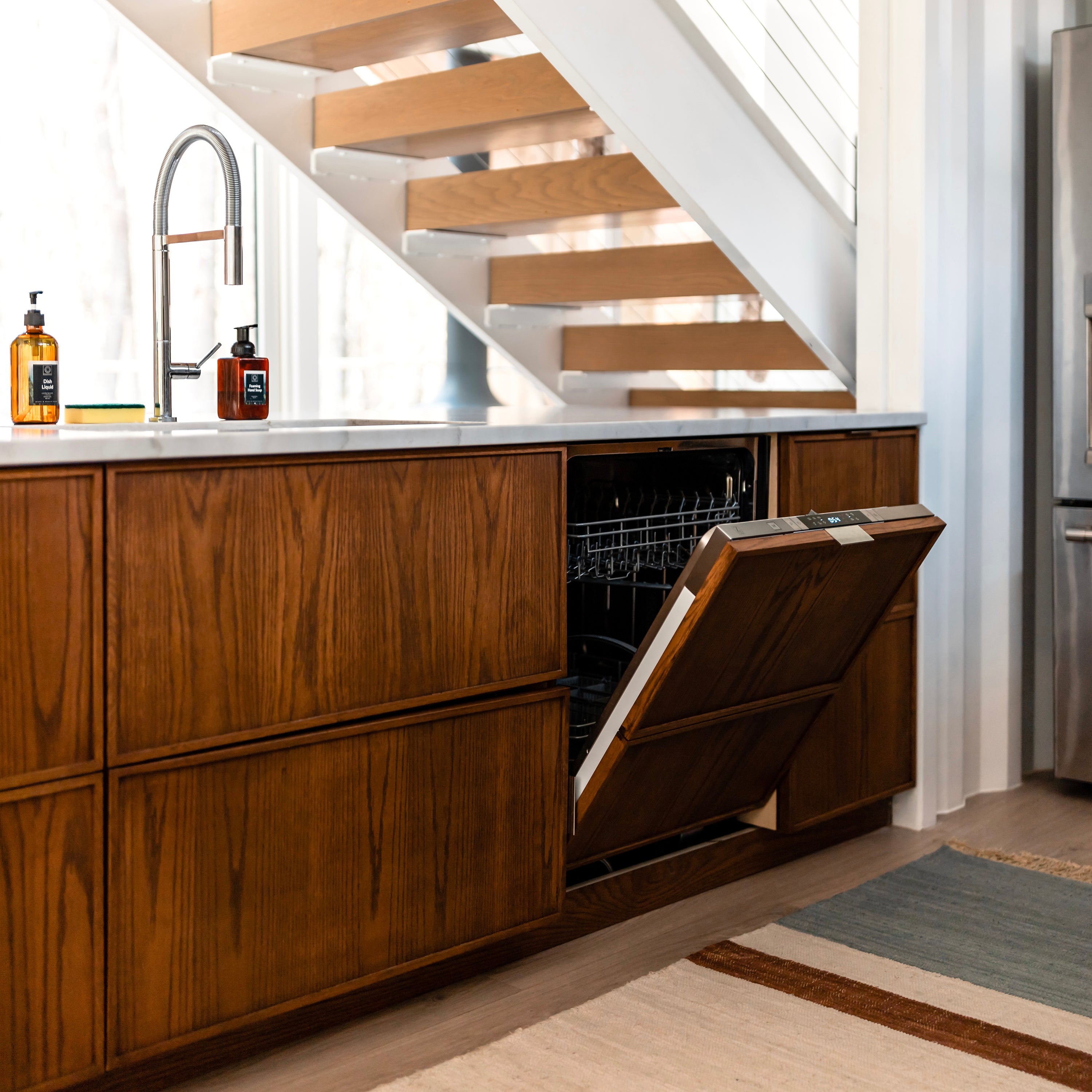
Dishwashers are one of the most-used appliances in any kitchen and one of the most under-researched. Most homeowners spend hours comparing ranges and refrigerators, then pick a dishwasher based on whichever model has the right finish at the right price. The result is often a dishwasher that's louder than they want, less effective than they expected, and out of place visually with the rest of the kitchen.
A few real decisions — made deliberately — can dramatically improve the dishwasher you live with for the next 10–15 years. This guide walks through the real choices: what type of dishwasher, what control style, what specs actually matter, and which features are worth paying for.
What's in this article
The First Decision: Stainless, Panel-Ready, or Integrated
This is the decision that affects how the dishwasher reads visually in your kitchen.
Stainless (or Color-Front) Dishwasher
The dishwasher has a stainless steel (or matching finish) front panel that's visible as an appliance. This is the most common configuration and what most homeowners default to.
Pros:
- More affordable than panel-ready or integrated
- Easier to install (no custom panel work required)
- Coordinates with stainless ranges, ovens, and refrigerators
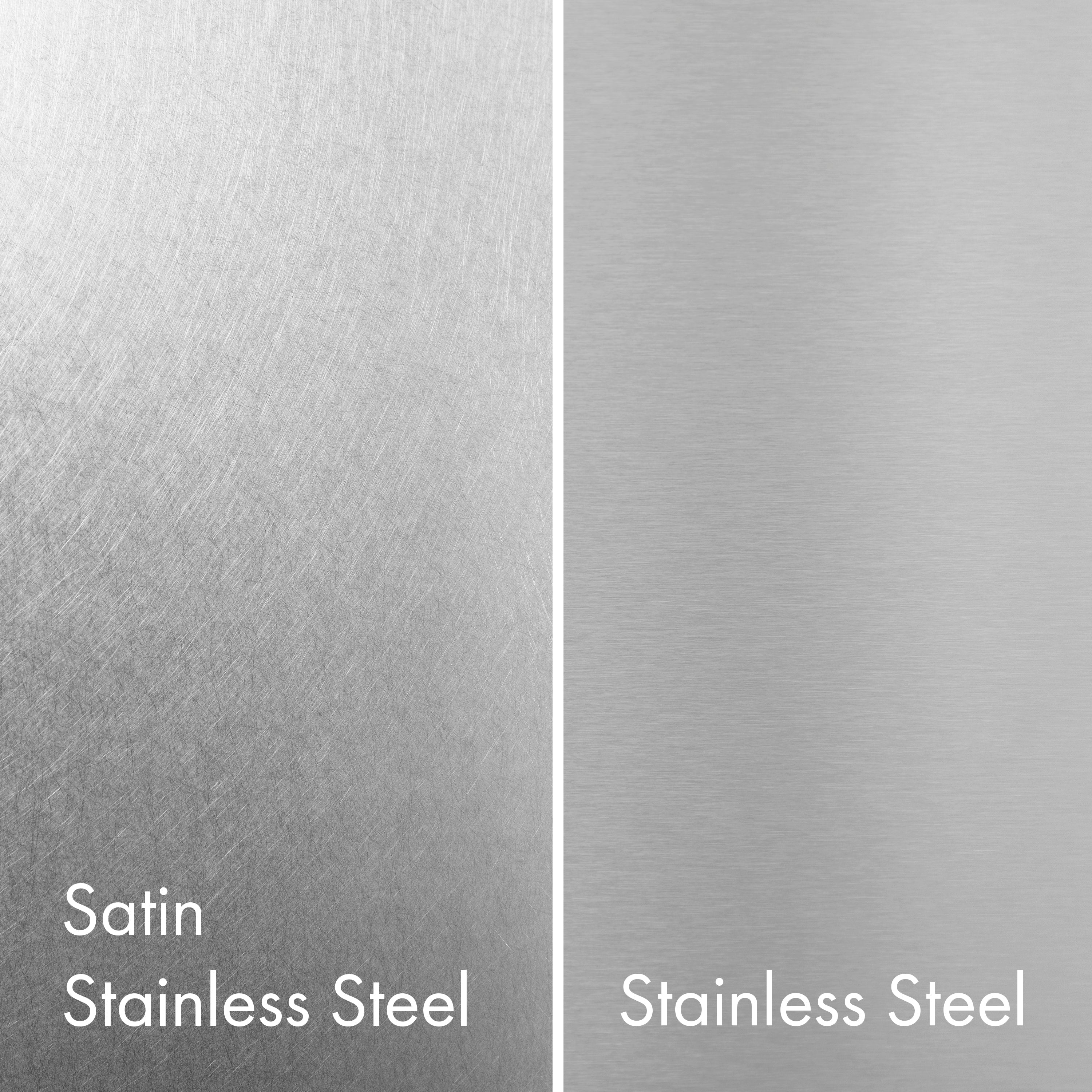
- Many finish options (classic stainless, DuraSnow®, black stainless, with hardware accents)
Cons:
- The dishwasher is visible as an appliance, which can interrupt a designed kitchen aesthetic
- Stainless surfaces show fingerprints (though DuraSnow significantly reduces this)
Panel-Ready Dishwasher
A panel-ready dishwasher accepts a custom door panel that matches your cabinetry. From the front, the dishwasher disappears entirely — it looks like another base cabinet.
Pros:
- Visually disappears into the cabinetry for a fully custom look
- Particularly valuable in kitchens where the cabinetry is a major design element
- Dramatically cleaner aesthetic in open-concept and design-forward kitchens
Cons:
- More expensive than stainless equivalents
- Requires a cabinet maker to build the matching panel (worth working with a shop that understands appliance panels — see our kitchen cabinets guide for how we think about this side of the build)
- Installation is more complex
Fully Integrated Dishwasher
An integrated dishwasher takes panel-ready a step further: not only is the door paneled, but the controls are hidden on the top edge of the door. From the front, there's literally no indication that it's a dishwasher at all — just a cabinet.
Pros:
- The most invisible installation possible
- Top of the line for high-end custom kitchens
- Best aesthetic for kitchens where the dishwasher is in a prominent visible run
Cons:
- Highest cost
- Cycle status not visible at a glance (some users miss this; many prefer it)
- Requires a custom panel like a panel-ready unit
How to Decide
If your dishwasher is in a tucked-away spot and the kitchen has a stainless appliance suite, stainless front is fine. If the dishwasher is in a visible run of cabinetry and the rest of the kitchen has been designed for visual coherence, panel-ready or integrated is worth the investment.
A useful test: imagine the kitchen photographed from the angle a guest would see when walking in. If the dishwasher front is in that frame, panel-ready becomes much more compelling.

Control Style: Top Control vs. Front Control
This is the second major visual decision, and it affects both aesthetics and usability.
Front Control
Buttons or dials on the front face of the dishwasher, visible and accessible without opening the door. Traditional configuration. Common on more affordable models.
Pros:
- See cycle status at a glance
- Press buttons without opening the door
- Generally lower cost
Cons:
- Visible controls interrupt the appliance's clean lines
- Less compatible with paneled or integrated installations
Top Control
Buttons are on the top edge of the door, visible only when the door is open. The front of the dishwasher is clean and uninterrupted.
Pros:
- Cleaner front aesthetic
- Required for fully integrated installations
- Becoming the dominant configuration in mid-range and premium dishwashers
Cons:
- Have to open the door to check cycle status (most have a small status light or projection on the floor to compensate)
- Slightly higher cost than equivalent front control models
For most residential kitchens being designed today, top control is the better choice. The cleaner front is meaningful, and most homeowners don't actually check cycle status often enough to miss the front display.
The Specs That Actually Matter
Beyond visual configuration, here are the specs worth caring about:
Decibel (dB) Rating
How loud the dishwasher is during operation. This is one of the few specs where the difference is genuinely noticeable in daily life.
| dB Rating | What It Sounds Like | Good For |
|---|---|---|
| 50+ dB | Loud enough to be intrusive | Not recommended |
| 45–50 dB | Audible but not disruptive | Closed-off kitchens |
| 40–44 dB | Background noise only | Open-concept floor plans |
| Under 40 dB | Nearly silent | Premium quiet operation — run during dinner parties |
For open-concept kitchens, prioritize 44 dB or quieter. The difference between a 50 dB and 42 dB dishwasher is dramatic — not just measured, but lived.
Third Rack
A shallow upper rack above the standard top rack, designed for utensils, ramekins, measuring spoons, and small items.
A third rack genuinely changes the way you use a dishwasher. It frees up space in the lower racks (no more silverware basket eating real estate), accommodates oddly shaped items, and substantially increases practical capacity. Once you've used a dishwasher with a third rack, going back is hard.
This is one of the few features that's worth paying for if your model offers it.
Adjustable Upper Rack
The top rack can be raised or lowered to accommodate tall items below or above. Useful for households that wash large stockpots, tall glasses, or oversized platters.
Hard Food Disposer vs. Filter
Older dishwashers had food disposers (essentially mini garbage disposals built in). Modern dishwashers typically use filtration systems instead — quieter, more efficient, but require occasional manual filter cleaning (every few months, depending on use).
This isn't really a decision you'll see advertised; almost all current dishwashers use filtration. The maintenance commitment is minor (5 minutes every few months) but worth knowing about.
Cycle Options
Most dishwashers offer 4–8 cycle options. The ones that actually matter for daily use:
- Normal — your default cycle for everyday loads
- Heavy — for pots, pans, and baked-on residue
- Express/Quick — shorter cycle for lightly soiled loads
- Sanitize — high-heat cycle for baby items, cutting boards, etc.
Twenty cycle options sounds impressive on a spec sheet, but in practice, most households use 2–3 cycles regularly.
Drying System
Three main approaches:
- Heated drying — traditional, effective, uses more energy, can damage some plastic items
- Condensation drying — uses residual heat from the wash cycle, more energy efficient, sometimes leaves moisture on plastic
- Auto-open drying / fan-assisted drying — door pops open or a fan circulates air to accelerate drying. Increasingly common on premium models. Most effective.
If you wash a lot of plastic containers, drying performance matters more than you might expect. Certain premium drying systems may also qualify for energy efficiency incentives — worth checking our guide to Utah's energy efficiency kitchen rebates if you're building in-state.

18-Inch vs. 24-Inch
Most residential dishwashers are 24" wide. 18" compact dishwashers exist for specific situations.
24" (Standard)
The default. Holds 12–16 place settings depending on configuration. Best capacity-per-cycle. Compatible with most kitchen layouts.
18" (Compact)
Holds about 8 place settings. Useful when:
- Kitchen layout simply can't accommodate a 24" (galley kitchens, very tight footprints)
- Adding a secondary dishwasher to a butler's pantry, bar, or outdoor kitchen
- Studio apartments, ADUs, or vacation properties (common ask for Park City ski condos and Heber getaways)
For primary kitchen use, 24" is almost always the right answer. The capacity difference matters more than the width savings.
Should You Have Two Dishwashers?
This is increasingly common in serious entertaining kitchens, and worth considering during a remodel.
The case for dual dishwashers:
- One running while you load the second is genuinely transformative for hosting
- Allows separation of "dishes that need a heavy cycle" from "dishes that just need a rinse"
- Pays for itself for households that entertain regularly
The case against:
- Significant cost increase
- Cabinet space dedicated to a second dishwasher
- Most households genuinely don't need it
If you host more than once a month, dual dishwashers are worth serious consideration. If you're hosting twice a year, one dishwasher is fine. (We include dual-dishwasher configurations in several of our larger kitchen builds — see our kitchen appliance packages guide for how they fit into the "Entertainer's Kitchen" and "Serious Cook's Kitchen" configurations.)
Smart Features: Useful or Marketing?
Modern dishwashers increasingly offer Wi-Fi connectivity, app control, and smart home integration. Honest assessment:
Genuinely useful:
- Cycle completion notifications on your phone
- Remote start (run the dishwasher when you leave the house, on a schedule)
- Diagnostic alerts (the machine telling you about its filter, water hardness, etc.)
Mostly marketing:
- Voice control ("Hey, start the dishwasher") — rarely used in practice
- App-based cycle selection — usually faster to just press the button
If smart features are a no-cost addition on a model you'd pick anyway, fine. If they add meaningful cost, prioritize the dB rating and third rack instead.
Installation Considerations
A few things worth confirming before you order:
- Cutout dimensions — 24" dishwashers fit standard 24" cabinet openings, but always verify.
- Water supply and drain — connections are standard, but plumbing routes can affect installation cost.
- Electrical — most dishwashers use a standard 120V outlet, but some require hardwired installation.
- Door clearance — make sure the door swing doesn't conflict with adjacent cabinet doors or drawers when fully open.
For panel-ready and integrated installations, plan the panel construction with your cabinet maker before ordering. Panel weight, hinge requirements, and trim allowances all matter — and this is exactly the kind of coordination we walk customers through every week.
ZLINE Dishwashers at Smart Home Luxury
Smart Home Luxury carries ZLINE dishwashers in stainless, DuraSnow® stainless, black stainless, and panel-ready configurations, with top-control models available across the lineup. Most models include third racks, adjustable upper racks, and decibel ratings competitive with premium designer brands. As with the rest of the ZLINE suite, the dishwasher coordinates with matching finishes across your range, hood, refrigerator, and microwave — one of the strongest reasons to build around a single brand, as we cover in our ZLINE attainable luxury post.
Coordinating a dishwasher with your full appliance suite is one of the easier package decisions to make right — and one of the easier ones to make wrong if you treat it as an afterthought.
Picking a Dishwasher for Your Kitchen?
Our specialists can walk you through the configuration choices and recommend the right model for your kitchen layout, budget, and design. We'll also include the dishwasher in a coordinated package quote if you're building the full suite. No call centers. No bots. Just real experts helping you choose right.
Shop Dishwashers Build a Kitchen Package Shop Ranges
Talk to a kitchen specialist: (888) 977-8994 | Mon–Fri 9–5 MST
Visit our showroom: 4375 W 1980 S, Salt Lake City, UT 84104
Smart Home Luxury is an authorized ZLINE and Proline dealer based in Salt Lake City, Utah. We serve the entire Wasatch Front — from Ogden to Provo — with nationwide shipping on every order.